Showing posts with label Anaconda. Show all posts

Sunday, May 10, 2020

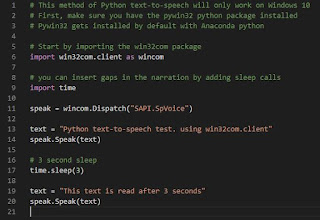
Easy Text-to-Speech in Windows 10 Using PyWin32

Some time back, we've talked about how to build a speech recognition system in Python. Now let's look in to the other end of it: how to make a Python program that talks. More specifically, let's looks at building a text-to-speech system.

There are several libraries out there that would let you build a text-to-speech model: gTTS, tts_watson, Pyttsx, etc. But today, we'll be talking about using PyWin32 on Windows 10.

Windows 10 has a built-in speech engine, and you can access it through the PyWin32 library. As it uses the built-in system, it's quite efficient than other TTS methods on Windows, and does not require any external tools to playback the audio.

The PyWin32 library gets installed automatically if you're using Anaconda Python. If it's not installed, you can install it using either `conda install pywin32` or `pip install pywin32`.

Text-to-speech with PyWin32


Sunday, December 29, 2019

How to Install TensorFlow 2.0 on Anaconda (with CUDA support)

TensorFlow 2.0 has been released for a few months now. This latest version comes with many new features and improvements, such as eager execution, multi-GPU support, tighter Keras integration, and new deployment options such as TensorFlow Serving.

So, it's time we all switched to TensorFlow 2.0.

TensorFlow 2.0


The Anaconda-native TensorFlow 2.0 packages are now available in the main conda repository. So, let's see how we can install TensorFlow 2.0 on Anaconda Python. This method will work on both Windows and Linux. And, if you have a CUDA capable NVIDIA GPU, you can enable GPU support as well.

Step 1.Creating a New Conda Environment


We'll start by creating a new conda environment. (I'll name it 'tensorflow2'. You can choose another name if you like):

conda create --name tensorflow2 python=3.7 anaconda


Create a new conda environment

Monday, December 16, 2019

How to Build and Install the Latest Version of Dlib on Anaconda on Windows

Dlib is a toolkit for C++ and Python containing machine learning algorithms and tools for creating complex software to solve real world problems. Dlib provides algorithms for machine learning/deep learning, multi-class classification and clustering models, support vector machines, regression models, a large set of numerical algorithms for areas such as matrix manipulations and linear algebra, graphical model inference algorithms, and utility algorithms for computer vision and image processing. And due to C++ implementations backing most of these implementations, they’re optimized to the point that can be used in some real-time applications as well.

If you’re interested in facial recognition models or facial emotion processing, then Dlib is a library you should definitely try out.

Dlib v19.19 in action on conda on Windows

But with all the great features in Dlib, installing it has always been a little bit troublesome because of some specific dependency requirements it needs which had a habit of almost always conflicting with your other libraries. With the latest versions however, installing Dlib has become somewhat simple.

If you’re using Anaconda Python for your python experiments, like me, you’ll find that there is no native Dlib package in the native conda package list. In one of my earlier tutorials I showed how to install the Dlib conda package from the conda-forge channel in to your conda environment. The conda-force package works perfectly fine, and it’s still one of the quickest ways to install Dlib.

But if you really want the latest official package of Dlib installed (v19.19 as the latest at the time of this writing) then using the pip package is the way to go. In order to install the Dlib pip package you’ll first have to setup some dependencies.

Monday, May 20, 2019

Installing OpenCV got easier

OpenCV is undoubtedly the unmatched de facto standard library for computer vision. Not only does it provide a near complete set of vision algorithms, the set of primitive graphics functions it provides to manipulate images makes it essential to many of our projects.

OpenCV being used when building a Keras CNN model

Installing the latest version of OpenCV used to be hard. The pre-built binaries available was never up to the tasks we wanted. Compiling from source was an option, but was tedious and time consuming.

Then, we got the anaconda versions of OpenCV from Conda-Forge, which we could simply install using,

conda install -c conda-forge opencv

Now, things are going to be simpler, as Anaconda native OpenCV packages are now available.

Thursday, November 22, 2018

Installing the New Anaconda Native TensorFlow Package

For a while now, the most reliable two ways to get TensorFlow installed is to either use the pip package, or compile from source.
Compiling TensorFlow from source takes hours, and still prone to errors (see "Failed Attempts at Building TensorFlow GPU from Source"). While the pip package is relatively easier, getting the GPU version of TensorFlow installed using pip was a hassle.

But not anymore. Because the conda native TensorFlow packages are here now.

Installing is quite easy.

Note: Don't install the pip and conda versions of TensorFlow on the same conda environment. If you already have the pip version installed uninstall it using,

pip uninstall tensorflow


To install the CPU version of TensorFlow, just run,

conda install tensorflow


To install the GPU version,

conda install tensorflow-gpu


Thursday, August 23, 2018

Cleaning up your Anaconda installations

If you've been using Anaconda Python for a while, and been creating multiple environments and adding/removing packages, you may have noticed that it's starting to take up a lot of disk space (sometimes tens of GBs).

Anaconda installation can get big


One reason is that anaconda environments are completely isolated workspaces from each other with their own copy of Python. So, the more environments you have, the larger the space needed by anaconda. But the other reason is that anaconda keeps a cache of the package files, tarballs etc. of the packages you've installed. This is great when you need to reinstall the same packages. But, over time, the space can add up.

So, how do we clean up this cache and regain some disk space?

Monday, May 14, 2018

Fixing the Matplotlib PyPlot import errors

About a week back, I was reinstalling Keras, TensorFlow and all the other libraries after a reformat of my PC. When I started verifying the library installations, I came across a strange error. When I tried to run a simple deep learning model, Python runtime crashed. As soon as I execute the script I was getting the "python.exe has stopped working" error message (I'm using Windows 10).

Matplotlib is an important part of my deep learning workflows
A little bit of debugging narrowed down the error to the following line in my script.

import matplotlib.pyplot as plt

(I was using matplotlib to graph the training history of the model. See "How to Graph Model Training History in Keras")

The error did not occur if I simply import matplotlib. It only occurred when specifically importing the pyplot module.

import matplotlib
# no errors

import matplotlib.pyplot as plt
# crash!!!

This is a known issue due to some library conflicts in the installation, which should hopefully be fixed in a future release. Until then, if you're getting this error, you can fix it by following the steps below.

Tuesday, May 23, 2017

OpenCV 3.2 and Dlib 19.4 Packages Now Available from Conda-Forge

Anaconda is an asset for us Machine Learning enthusiasts. Not only does it have the ability to create fully isolated Python environments, its pre-built packages for many operating systems and architectures helps you to spend less time setting up, and more time doing actual machine learning stuff.

In some scenarios, to get some Python packages to work in certain environments, getting them from Anaconda was the only way that worked. If you tried installing Dlib or OpenCV 3 on Windows 64-Bit, then you know the effort it takes to get them setup, if it wasn't for Anaconda.

OpenCV and Dlib working perfectly together, thanks to Conda

If you check my posts on Installing Dlib on Anaconda Python on Windows, and Installing OpenCV 3 on Anaconda Python 3.5 on Windows, you know how easy it is to use conda to install them on Python 3.5 64-Bit on Windows.

But there was a catch: The Anaconda registry only had OpenCV 3.1 and Dlib 19.0 - not the latest versions.

Wednesday, May 3, 2017

Visualizing Keras Models - Updated

About 2 months back, I did a post on how you can visualize the structure of a Keras model. As I mentioned, when the machine learning (or deep learning) model you're building is complex, then it may be easier to understand it if you can see a visual representation of it.

I showed you how to use the Visualization utility in Keras in order to draw the structure of a model in Keras, such as this visualization of the LeNet model,

Visualizing the LeNet model

But a few days back, several people had got some errors when following the steps I explained. I digged a bit to find why the errors are happening, and found that with the latest version of Keras (v 2.*) they have changed the API of the visualization utility.

The following are the main changes,
  • The module has been renamed, from visualize_util to vis_utils.
  • The function name for plotting has been renamed, from plot to plot_model.
So, here's the updated guide on how to visualize a Keras model.

Wednesday, February 8, 2017

Installing OpenCV 3 on Anaconda Python 3.5 on Windows

If you checked my last post, you know that TensorFlow now officially works on Windows. This was really exciting to me, since I was using a Linux machine for my TensorFlow experiments, I had to switch between the Linux and Windows for my other tasks. Now, I should be able to perform some of those experiments on Windows as well. (I would still switch to Linux for more processor intensive deep learning models). So, I decided to set everything up on Windows again.

I've been using OpenCV 3 on Anaconda Python 3.5 on Linux. (Check out my guide on Installing OpenCV from source on Anaconda Python on Ubuntu 16.10 if you are trying to install on Linux). But on Windows, I've previously only tried OpenCV on Python 2.7. Since the OpenCV Downloads page has pre-built binaries for OpenCV 3 (version 3.2 being latest), I thought the installation would be straightforward.

I downloaded and ran the OpenCV 3.2 installer (which just extracts OpenCV to a directory of your choosing), set the OPENCV_DIR environment variable, add the bin dir in OpenCV to the PATH, and finally copy the cv2.pyd file to the site-packages directory in my Anaconda environment. I fired up the Anaconda environment, and tried loading cv2 in Python. But I got the following error,

 (tensorflow) C:\>python  
 Python 3.5.2 |Continuum Analytics, Inc.| (default, Jul 5 2016, 11:41:13) [MSC v  
 .1900 64 bit (AMD64)] on win32  
 Type "help", "copyright", "credits" or "license" for more information.  
 >>> import cv2  
 Traceback (most recent call last):  
  File "<stdin>", line 1, in <module>  
 ImportError: DLL load failed: The specified module could not be found.  

Sunday, January 8, 2017

Installing OpenCV from source on Anaconda Python on Ubuntu 16.10

I recently switched to Linux for my Machine Learning experiments, and I did a post on How to install Keras and Anaconda Python on Ubuntu 16.10.

Now, I wanted to install OpenCV on Ubuntu also. Since OpenCV does not have a pre-built package for Linux, it meant I had to compile OpenCV from source.

OpenCV 3.1 running on Lubuntu 16.10

Adrian of PyImageSearch has recently done a post about how to compile OpenCV on Ubuntu 16.04 using virtualenv. I followed his steps as a base, but had to make numerous adjustments to some of the packages which gets installed (e.g. libpng-dev, libhdf5-serial-dev) and the build commands due to the changes from Ubuntu 16.04 to 16.10, and because I'm using Anaconda environments rather than virtualenv.

I'll be installing OpenCV 3.1, and will be using the Lubuntu 16.10 virtual machine which I used in my earlier post. But the steps and commands will be exactly the same for any flavor of Ubuntu 16.10.

First, as a habit, get and install the latest updates for Ubuntu,
 sudo apt-get update   
 sudo apt-get upgrade   

Then (if you have not done already) install the necessary build tools,
 sudo apt-get install build-essential cmake git unzip pkg-config  

Then, we install the following packages which allows OpenCV to interact with various image and video formats,
 sudo apt-get install libjpeg8-dev libtiff5-dev libjasper-dev libpng-dev  
 sudo apt-get install libavcodec-dev libavformat-dev libswscale-dev libv4l-dev  
 sudo apt-get install libxvidcore-dev libx264-dev  

Note: on Ubuntu 16.04, the package name for libpng was libpng12-dev. But on 16.10, it should be libpng-dev.

Saturday, November 19, 2016

Setting up Keras and Anaconda Python on Ubuntu 16.10

I’ve been using Anaconda Python for most of my Machine Learning experiments, mainly because of the flexibility it gives with the isolated Python environments. I recently did a post on how to install Keras on Anaconda on Windows.

I’m planning to switch to Linux for few of my experiments, so I decided to try out setting up Anaconda Python and Keras from scratch on Ubuntu. I’ll be using the latest Ubuntu 16.10 (Yakkety Yak) 64-Bit for this.

Note: The screenshots I captured are from a virtual machine with Lubuntu 16.10 (the LXDE flavor of Ubuntu). But the steps and commands are exactly the same for the standard Ubuntu desktop as well.

First and foremost, get and install the latest updates in Ubuntu, (Reboot the machine if necessary after updating.)
 sudo apt-get update  
 sudo apt-get upgrade  

Then, we’ll install the following necessary packages,
 sudo apt-get install build-essential cmake git unzip pkg-config  
 sudo apt-get install libopenblas-dev liblapack-dev  

Now, on to installing Anaconda. Head over to the Anaconda Python Downloads page, and get the Linux installer for Anaconda. We’ll be getting the Python 3.5 64-Bit package.
Go to the Anaconda Download page and download the Anaconda Python 3.5 64-Bit package for Linux
Download the Anaconda Python 3.5 64-Bit package for Linux

This will download a file named Anaconda3-4.2.0-Linux-x86_64.sh (the version numbers might be different based on the latest version available at the time of the download).

Tuesday, October 25, 2016

Installing Dlib on Anaconda Python on Windows

Update - 16/Dec/2019: There is now an easier way to install Dlib from the official pip package. Check out the new tutorial How to Build and Install the Latest Version of Dlib on Anaconda on Windows


Dlib is a Machine Learning library, primarily written in C++, but has a Python package also. It has many useful and optimized algorithms useful for machine learning, linear algebra, data structures, image processing, and much more available out-of-the-box.
"Dlib is a modern C++ toolkit containing machine learning algorithms and tools for creating complex software in C++ to solve real world problems. It is used in both industry and academia in a wide range of domains including robotics, embedded devices, mobile phones, and large high performance computing environments. Dlib's open source licensing allows you to use it in any application, free of charge." - dlib.net
One of the most popular features in Dlib is Facial Landmark Detection. Dlib installation ships with a pre-trained shape predictor model named shape_predictor_68_face_landmarks.dat, which as the name suggests, is trained to detect 68 facial keypoints including eyes, eyebrows, mouth, nose, face outline, etc.

Dlib's Facial Landmark Detection in action
You can view the sample code for face landmark detection here at the Dlib website, and download the pre-trained model from http://dlib.net/files/shape_predictor_68_face_landmarks.dat.bz2
(Make sure to unzip the .bz2 file once you download it)

Of course, Dlib is capable of much more than face landmark detection. I'm hoping to dig into some cool features of Dlib in later posts.

But first, we need to install it.

Getting Keras working with Anaconda Python

I've started using the Anaconda Python distribution for most of my Machine Learning. It has pre-built binaries of Python for many platforms and architectures, has hundreds of pre-built and tested Python packages directly available through the conda package manager, and it allows easy creation of virtual isolated environments - with its own Python version and packages - to experiment with.

You can get an idea of the capabilities of Anaconda by going through their Anaconda Test Drive guide.

Getting Keras (with Theano backend) working on any Python distribution is usually straightforward, but you do run into some errors occasionally based on the platform you're on and your environment settings.

So, here are the steps that worked for me to get Keras working on the Anaconda Python distribution:

First, you need to install Anaconda. It's as easy as getting the binary for your platform from Anaconda download page and running it. Once it's installed, the conda command will be available from your terminal or command prompt.

Now you can create an anaconda environment to install Keras and related packages,
 conda create --name keras-test numpy scipy scikit-learn pillow h5py mingw libpython  

'keras-test' is the name of the environment we're creating. You can give it a different name.
You can also create an environment with a different Python version. For example, if you want to create the environment with Python 2.7,
 conda create --name keras-test python=2.7 numpy scipy scikit-learn pillow h5py mingw libpython  

Once the environment is created, activate it.
 activate keras-test  

Then, we'll install Theano from Git, since we want the latest development version,
 pip install --upgrade --no-deps git+git://github.com/Theano/Theano.git  

And then, we install Keras from PIP,
 pip install keras  

Finally, we setup OpenBLAS and configure Theano to use it. My earlier blog post - Getting Theano working with OpenBLAS on Windows - details how to setup Theano with OpenBLAS in detail.

We can test whether the setup was successful by running the Python interpreter and importing Keras package,
 python  
 >>> import keras  
 Using Theano backend.  

Keras loading successfully


If you don't get any errors when the Keras package is loading, then all is set.

Related posts:
Switching between TensorFlow and Theano on Keras
What is the image_dim_ordering parameter in Keras, and why is it important

Related Links:
https://www.continuum.io/downloads
https://docs.continuum.io/anaconda/pkg-docs
http://conda.pydata.org/docs/test-drive.html

Build Deeper: Deep Learning Beginners' Guide is the ultimate guide for anyone taking their first step into Deep Learning.

Get your copy now!